
Lucrecia Sodo is a visual artist and architect who began painting in adolescence. From then on, alongside her secondary and university studies, she painted works and objects that found a place in the local art scene. Upon finishing her Architecture studies in 2001, she started a degree in Fine Arts and joined the Experimental Print and Silk-Screen Workshop at the Centro Cultural Rojas (Buenos Aires), determined to explore new forms of visual expression. She held several exhibitions in Buenos Aires and Rosario between 2003 and 2006, and led the Design and Art Coordination Area at the Silk-Screen Workshop of the Centro Cultural Arturo Jauretche. In 2007 she moved to Mexico, where she ventured into engraving techniques and ceramic art. She was General Coordinator at the architecture firm PRODUCTORA and has since launched her own venture.
What led you to study architecture and visual arts?
From a young age I loved drawing, illustrating stories, and painting, and I attended a children's ceramics workshop. In primary and secondary school, you had to choose between visual arts and music, and I always chose visual arts. At my childhood home I'd find leftover paint and wood from some repair and was always inventing something. When I started thinking about university, I was torn between Architecture and Fine Arts. My mother is an architect, so it was easier for me to imagine a professional life in architecture. I didn't know any visual artists outside of my ceramics teacher, my high school art teacher, and a few amateur artists in my hometown who painted on the side. Since I don't enjoy teaching and didn't understand what other career paths an artist might have, I decided to study architecture. I graduated in 2000 and immediately began Fine Arts, though I only studied two years and continued my training through courses and workshops. Later, living in Rosario and engaged with its cultural scene, I understood that I wanted — and could — also dedicate myself to art.
What is your creative process?
I've always worked with imagination, trying to bring forms or combinations of elements and colors into reality. Once an idea exists in the world — with its texture, scale, and unfolding in time — it always surprises and stimulates me. That's where the pleasure of discovery lies, and where curiosity about exploring the variants of an aesthetic proposal appears.
In my work I sometimes need the figurative to better represent certain metaphors — the human body as a reference for identifying sensations and locating ourselves in a context, around how we may feel in relation to the world and to ourselves. Those feelings are deeply personal yet universal, and each viewer surely interprets them differently.
Other times, I prefer abstract forms, where the path of lines and the movement they describe can speak of intentions: leaving, entering, beginning, returning, opening, closing — vital actions we all understand.
In my more recent work I use modules built with a geometric logic — meaning the forms within each module have precise contact points and enable the generation of patterns. Through this expressive search I've discovered a graphic language for creating a proliferation of imagined worlds, where the generating modules cease to be distinguishable and merge into a complex composition.
What do you look for when intervening spaces?
When intervening a space, I look to transform it and amplify it. Each space has special qualities of size, light, proportion, texture, etc. To me, these characteristics are major constraints that shape the intervention and its intent. Both the chosen colors and the density and extension of the forms create a new spatial quality. You can work with strong contrast to highlight the existing materiality and differentiate it from the intervention, or you can act more harmoniously, fitting in with what's there to create a unity. The options are many and not always easy to choose between — I try to advance with what I most enjoy and dive in without looking back.
What led you to collaborate with PRODUCTORA, and what did you enjoy about working there?
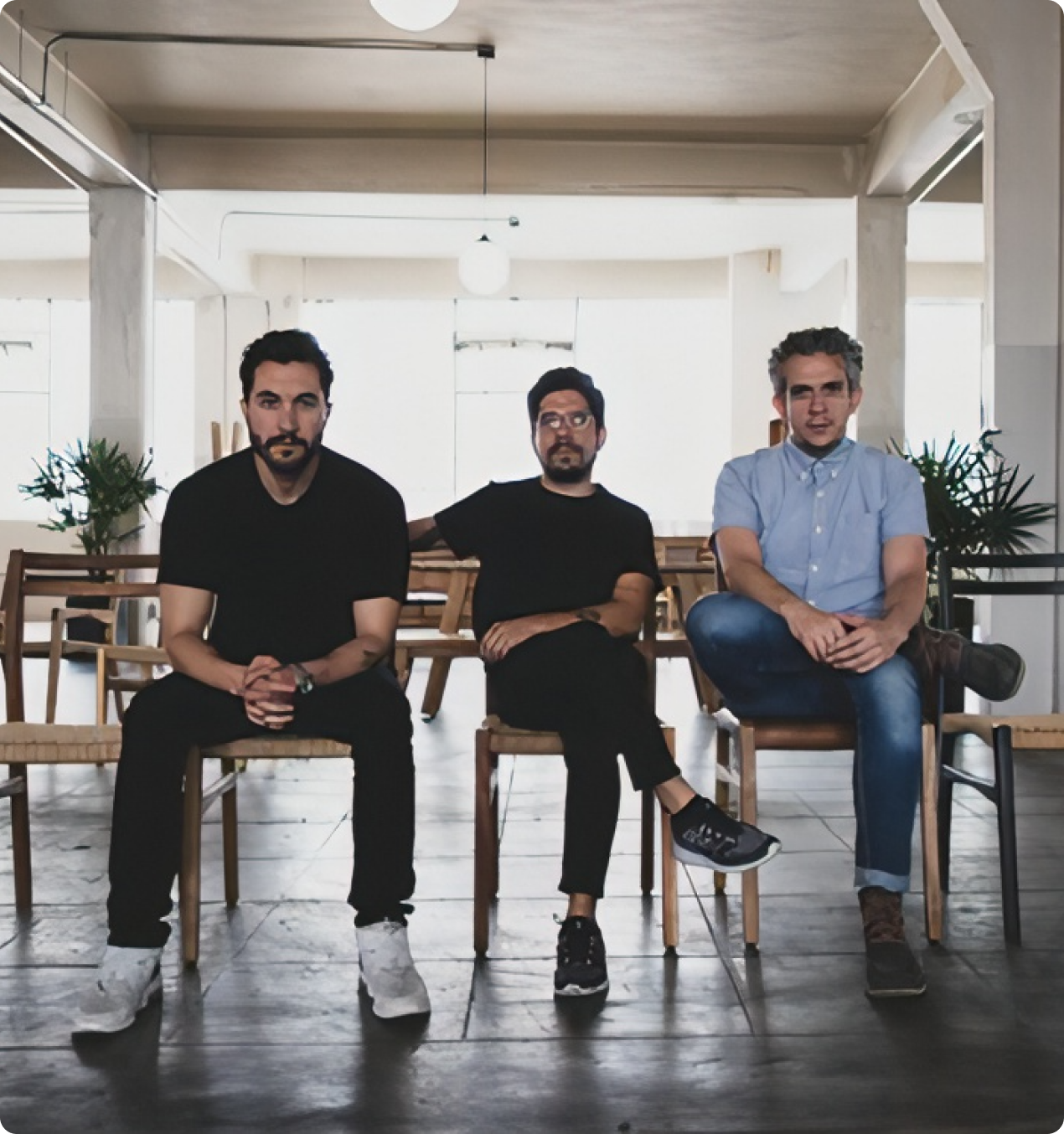
I arrived in Mexico in 2007 determined to work only on art projects when I happened to meet PRODUCTORA's partners. I was mostly doing ceramics and engraving at the time. From the moment I encountered the office, I was fascinated by this project focused on contemporary Mexican architecture, engaged with national and international competitions and calls. When they invited me to work with them, I felt a new and enriching world would open — and so it did. Through PRODUCTORA's projects I met architects and artists who remain references for me. I worked at PRODUCTORA from March 2008 to June 2021 — a little over 13 years — as General Coordinator, a role that grew as the office grew. I greatly enjoyed being part of this project, because my view had to encompass everything that happened and everything that makes an architecture office work: I could understand the development of the projects, the relationship with clients, the office's image and press, the formation of teams, the selection and maintenance of our space's equipment, the agenda of activities, lectures, exhibitions, special events, and many more administrative and operational matters. I'm a very organized and responsible person (so they say… ha!) and contributing to the success of this great project — by understanding aspects of the profession that often aren't considered when one decides to be an architect — gave me a lot of satisfaction. PRODUCTORA was my home for many years; the active, collaborative work environment was always among the best. I made great lifelong friends there, and the four partners of PRODUCTORA are still close, dear friends.
How do you think art and architecture can improve people's lives?
Art and architecture can improve people's lives by addressing their primary needs — sensory, cultural, emotional, intellectual. Architecture and art act as a mirror of society, with all the historical weight that implies. Like all the arts, they feed off the ideologies of their time and try to express, resolve, and move forward. I believe there are different kinds of art and architecture in their expressive, political, and aesthetic intentions, but all together they form a body that can be analyzed globally or specifically in relation to context. Architecture usually responds to a function, and the matter is to resolve that requirement in the best possible way — considering efficiency, beauty, and innovation. Visual art, with no precise utilitarian aim, addresses viewers in order to stimulate, move, and awaken feelings and thoughts. There are different scales when answering this question — society, generation, the individual — so it's hard to give a single answer that captures the whole complexity. But I believe that in every case and every age people need art and architecture, and fortunately this possibility for freedom and expression — though there's still a long way to go — keeps becoming broader and more varied.
You can learn more about Lucrecia Sodo on her website https://lucreciasodo.com/ and on social media @luquisodo.